

CRIRSCO 2024 Template Update
The Committee for Mineral Reserves International Reporting Standards (CRIRSCO), established in 1994, is an association of representatives of organisations that are responsible for developing mineral reporting codes and guidelines. CRIRSCO currently includes 30 representatives from 15 countries and regions, and 6 candidates. The combined value of mining companies listed on the stock exchanges of these countries accounts for more than 80% of the listed capital of the mining industry.
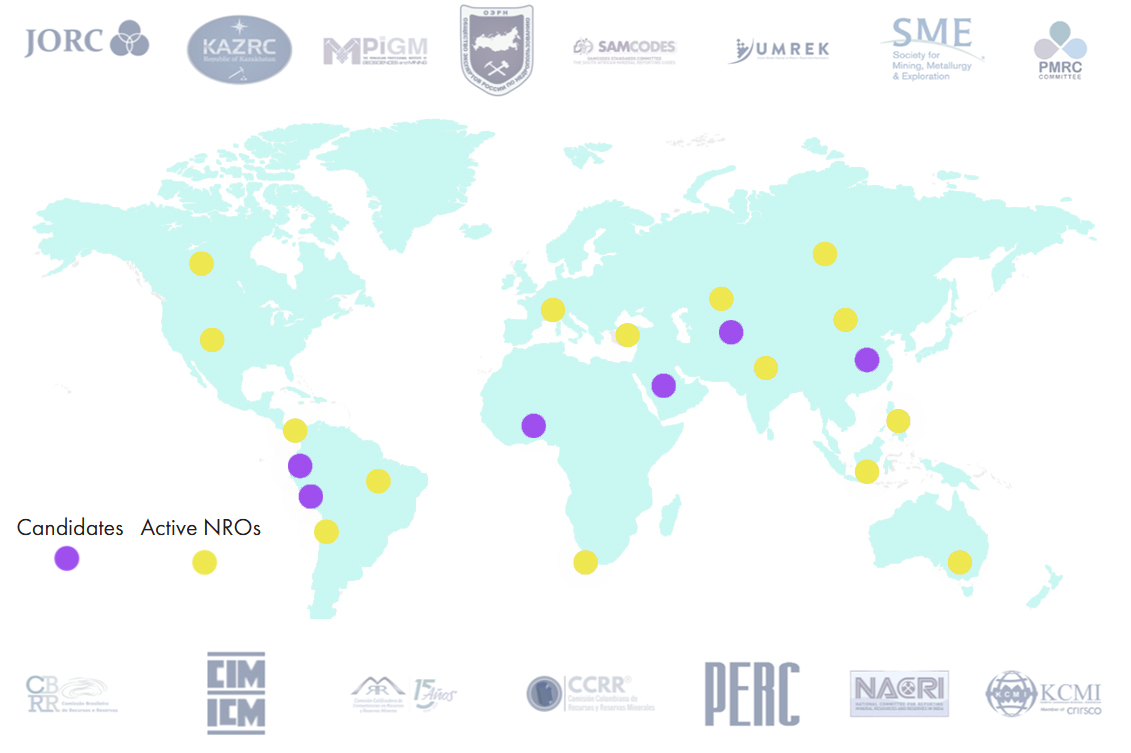
Based on the established reporting codes of its member countries, CRIRSCO has developed an International Reporting Template (the ‘Template’) to promote effective, proven practices for public reporting of exploration results, mineral resources and mineral reserves. On the one hand, CRIRSCO member organisations use the template to create and improve their own standards, and on the other hand, the best definitions, approaches and practices from regional standards are used to update the CRIRSCO Template.
Today, the main areas of CRIRSCO’s activities are:
-
- Updating the International Reporting Template,
- Assisting countries in developing national reporting standards,
- Alignment with the United Nations Framework Classification
In June 2024, CRIRSCO presented an updated version of the Template, which includes changes to some definitions and wording for clarification, alignment with each other and with other regulatory documents. Below is a review of the main changes included in the 2024 version of the CRIRSCO International Reporting Template.
| The term ‘Mineral’ has been replaced with ‘Material of Economic Interest’. | The more general term ‘Mineral’ has been replaced by the more accurate ‘Material of Economic Interest’, which is more appropriate for use in the context of mineral resources and mineral reserves. |
| Social media announcements have been added to the definition of ‘Public reports’. | Public reports now include social media announcements as a modern form of communication. |
| In the ‘Competent person’ definition, ‘or in accordance with the requirements of the local National Reporting Organisation’ regarding minimum relevant experience has been removed. | The Competent Person must have at least five years of relevant experience in the type of mineralisation or deposit under consideration and in the activities that the Competent Person is undertaking, regardless of the requirements of the local National Reporting Organisation. |
| In the ‘Modifying Factors’ definition, ‘governmental factors’ are replaced by ‘governance (ESG) and regulatory factors’. | The regulatory modifying factors group was expanded to include all relevant ESG aspects of the project (environmental, social and governance). |
| In the ‘Modifying Factors’ definition, ‘used to convert Mineral Resources to Mineral Reserves’ are replaced by ‘used to assess and estimate Exploration Targets, Mineral Resources and/or Mineral Reserves’. | The definition of ‘Modifying Factors’ has been amended to highlight that some consideration of the Modifying Factors is required from the early stages of geological exploration. |
| In the ‘Mineral Resource’ definition, ‘solid material of economic interest’ changed to ‘material of economic interest’. | The new definition of ‘Mineral Resources’ is more extensive and covers not only solid minerals, such as ‘liquid brines’ and other. |
| In the ‘Mineral Resource’ definition, ‘reasonable prospects for eventual economic extraction’ changed to ‘reasonable prospects for economic extraction’. | The wording was corrected because ‘prospects for eventual’ looked like a duplication. |
| In the ‘Indicated Mineral Resource’ definition, ‘sufficient to assume’ changed to ‘sufficient to demonstrate’. In the ‘Inferred Mineral Resource’ definition, ‘to imply but not verify’ changed to ‘to infer but not demonstrate’. | The definitions are updated to make a more logical transition between the three resource categories – Measured, Identified and Inferred. |
| The sentence ‘Mineral Reserves can be sub-divided, in order of increasing levels of confidence, into Probable and Proved Categories.’ was added to the definition of ‘Mineral Reserve’. | This explanation has been added to better consistency with the Mineral Resource definition. |
| The definition of ‘Life of Mine Plan (LoMP)’ has been added to the chapter on ‘Reporting of Mineral Reserves’. | This definition has been added to support the declaration of mineral reserves for operating mines. |
| In the ‘Scoping Study’ definition, ‘demonstrate at the time of reporting that progress to a Pre‐Feasibility Study can be reasonably justified’ changed by ‘demonstrate and provide justification for further investigation and technical work, and more comprehensive technical studies’. | Wording has been changed to take into account situations where scoping studies may not always be used to justify progression to a Pre-Feasibility Study. |
| The sentence ‘A Scoping Study is at a lower confidence level than a Pre-Feasibility Study’ was included in the ‘Scoping Study’ definition. | The sentence has been added to make the transition between ‘Scoping Study’ and ‘Pre-Feasibility Study’ more logical. |
| In the ‘Pre-feasibility Study’ definition, ‘a preferred mining method, in the case of underground mining, or the pit configuration, in the case of an open pit, is established and an effective method of mineral processing is determined’ changed by ‘the preferred methods of extraction and beneficiation have been determined’. | The wording has been changed to a simpler and more general one, but one that reflects the essence. |
| In the ‘Pre-feasibility Study’ definition, ‘a financial analysis based on reasonable assumptions’ changed by ‘financial analysis based on reasonable and demonstrated assumptions’. | This indicates the need to demonstrate the assumptions used for the modifying factors. |
| In the ‘Feasibility Study’ definition, ‘extraction is reasonably justified (economically mineable)’ changed by ‘economic extraction is reasonably justified’. | The wording has been changed to be consistent with the usage in other parts of the template. |
|
In ‘Figure 1. General relationship between Exploration Results, Mineral Resources and Mineral Reserves’, the title of X-axis has been changed. |
The title of the X-axis now does not include all groups of modifying factors. |

Considering that this update did not involve a full revision of the Template, the changes do not seem to be significant, but clarify and specify some definitions and items. It can be assumed that the update of the template will lead to update of the national reporting standards of CRIRSCO members.
The text of the Updated CRIRSCO 2024 Template is available here.
A summary of the changes included in the 2024 version of the CRIRSCO International Reporting Template can be found here.